The Complicated Legacy of Randy Johnson as a Mariner
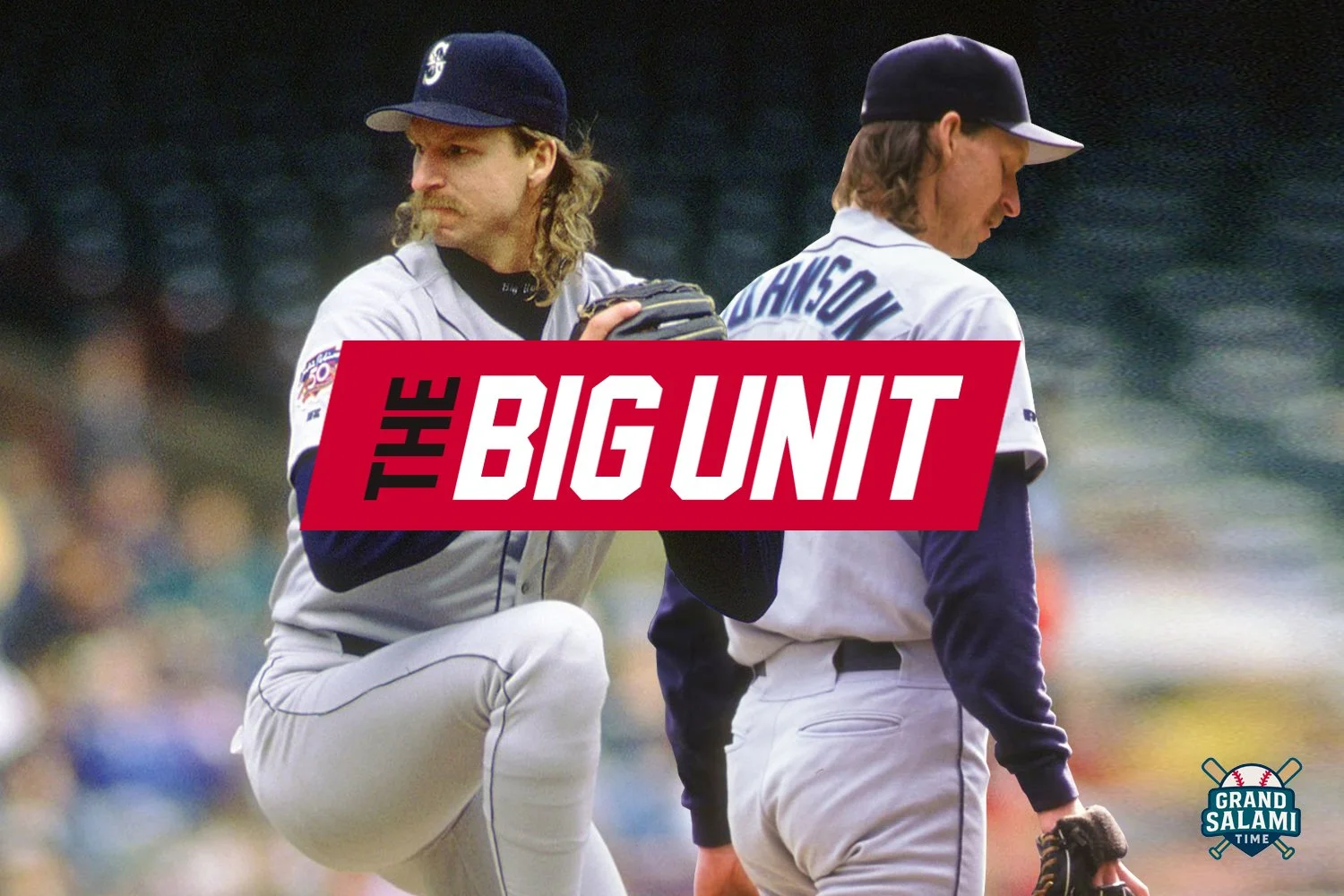
Randy Was Feared On and Off the Field
I still remember waiting with my dad outside the clubhouse area of the Kingdome after a Seattle Mariners game. Fans stood around hoping players might stop before heading home. Most either waved, signed something, or politely kept moving.
Then there was Randy Johnson.
The memory I have is him walking past looking genuinely irritated people were standing there. He did not stop, smile, or pretend to enjoy the attention. Honestly, that fit his reputation perfectly. Randy was feared on and off the field. Johnson was intense, intimidating, and at times openly confrontational with media and fans. That edge made him unforgettable because when he took the mound, that same intensity turned him into one of the most terrifying pitchers baseball has ever seen.
Which is what made this past weekend feel emotional, strange, and honestly a little bittersweet.
Johnson finally, and deservingly, had his No. 51 retired by the Mariners. There were tears, old stories, highlights from the glory days, and appearances from former teammates, coaches, and Hall of Famers. It was genuinely great seeing names like Lou Piniella and Nolan Ryan speaking about Johnson and what he meant to baseball. And yet, sitting there watching it all, I could not help but feel a little sadness too.
Not because Johnson did not deserve it. He absolutely did. In fact, he probably deserved it years ago. But it was hard not to notice that one of the greatest pitchers not only in Mariners history, but baseball history, could not completely sell out T-Mobile Park on a Saturday night, one year removed from the Mariners finally ending the playoff drought.
That disconnect is not really about Randy Johnson the player. It is about the relationship between Johnson and Seattle slowly fading over the years. At one point, Randy Johnson felt larger than the franchise itself. Then he left, went into the Hall of Fame as an Arizona Diamondbacks player, and for a long time almost felt disconnected from Seattle baseball entirely.
I found myself half jokingly wondering how much owner John Stanton had to pay Johnson to finally agree to this ceremony. But honestly, it was still the right thing to do. Because whether the relationship was complicated or not, it always felt strange that someone as important to Mariners history as Randy Johnson still felt somewhat disconnected from the franchise. Especially when Ichiro Suzuki’s No. 51 remained so closely tied to the organization and the city.
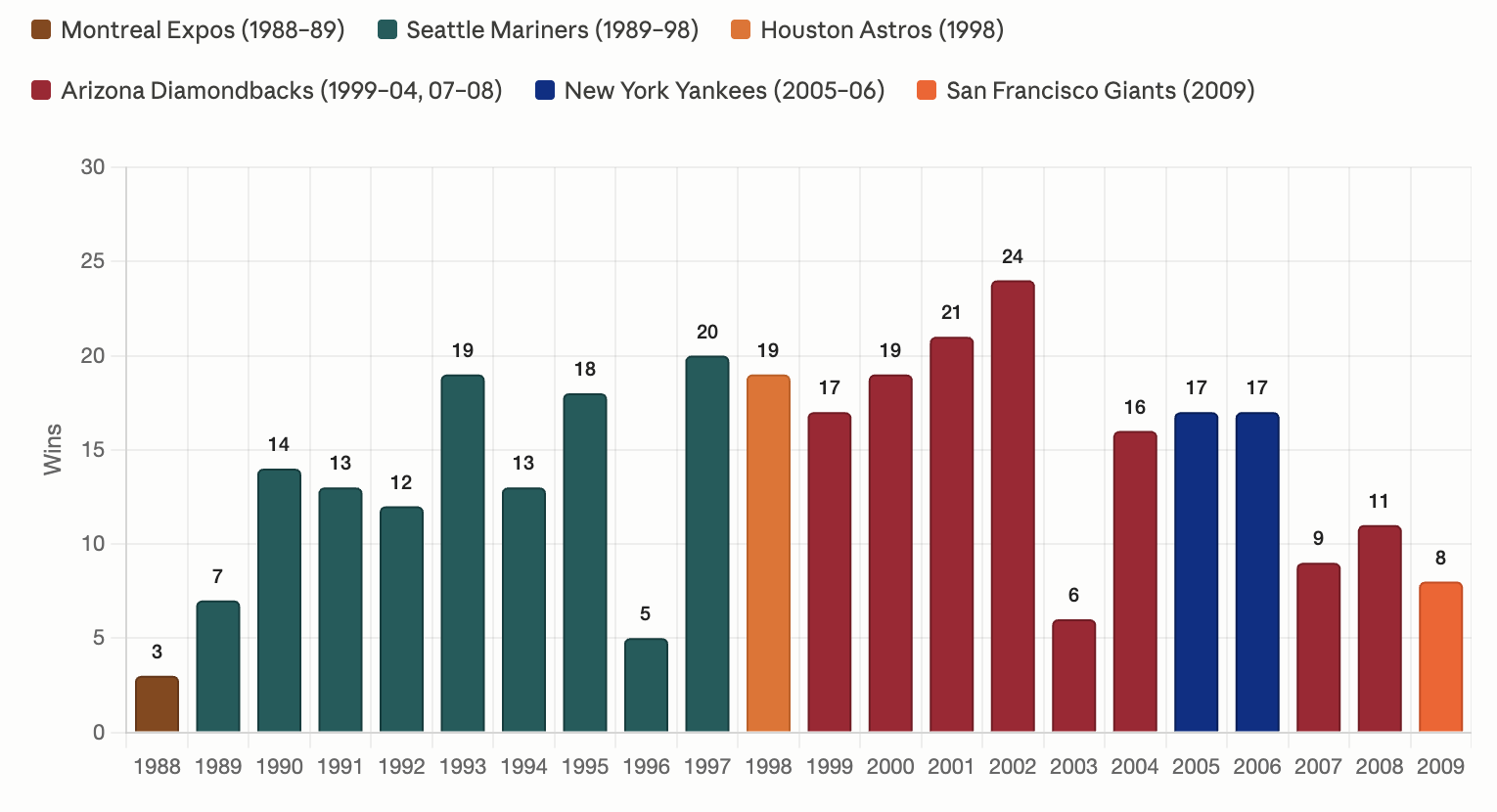
Randy Johnson Wins by year and team
Becoming a Mariners Legend
Before Johnson arrived, the Mariners were still trying to establish themselves as a serious franchise. Johnson helped change that.
Across 10 seasons in Seattle from 1989 through 1998, Johnson went 130-74 with a 3.42 ERA over 2,162 innings pitched. He struck out 2,162 batters as a Mariner and became one of the most dominant pitchers in baseball. At his peak, he felt unhittable.
From 1993 through 1997, Johnson became arguably the best pitcher in the sport. He won the 1995 Cy Young Award and went 18-2 that season with a 2.48 ERA and 294 strikeouts. Every start felt like an event. At six-foot-10 with long hair flying behind him and a fastball touching 100 miles per hour, Johnson looked more like a movie villain than a pitcher. The glare from the mound, the violent delivery, the slider disappearing across the plate, everything about him felt intimidating.
For a period in the mid-1990s, Randy Johnson was Seattle baseball.
The defining moment came during the unforgettable 1995 playoff run. The Mariners stormed back to win the AL West before facing the New York Yankees in the ALDS. Fans remember “The Double” from Edgar Martinez, and deservedly so, but Johnson’s role in that series remains legendary.
After throwing over 100 pitches in Game 3, Johnson returned on short rest out of the bullpen in Game 5 and shut the Yankees down across the final innings. The performance helped save baseball in Seattle and permanently cemented Johnson as a Seattle sports icon. Without Randy Johnson, there is a very real chance the Mariners do not survive in Seattle long enough for Safeco Field, Ichiro, Félix Hernández, or the modern era of Mariners baseball to ever exist.
The Trade That Changed Everything
That is why the ending felt so strange.
By 1998, the relationship between Johnson and the Mariners organization had clearly deteriorated. Johnson reportedly grew frustrated with ownership and the direction of the franchise, while the Mariners feared losing him for nothing in free agency. Then, on July 31, 1998, Seattle traded Johnson to the Houston Astros for Freddy García, John Halama, and Carlos Guillén.
For many fans, it felt personal.
Some believed Johnson had quit on Seattle. Others blamed ownership for allowing the relationship to collapse in the first place. Either way, the split created bitterness that lingered for years. The hardest part for Seattle fans was what happened next.
Johnson immediately dominated in Houston, going 10-1 with a 1.28 ERA in just 11 starts. Watching him become unstoppable somewhere else made the separation even more painful. Then somehow, after leaving Seattle, he became even better.
With Arizona, Johnson transformed from superstar into baseball immortal. He went 118-62 with a 2.83 ERA, won four straight Cy Young Awards, and helped deliver a World Series title in 2001 against the Yankees. Overall, he finished his Hall of Fame career with 303 wins, a 3.29 ERA, and 4,875 strikeouts across 22 seasons.
When Johnson entered the Hall of Fame, he wore a Diamondbacks cap instead of a Mariners cap.
For Seattle fans, that hurt.
Seattle was where Johnson became Randy Johnson. The Mariners developed him from a wildly inconsistent pitcher into one of the most dominant forces baseball had ever seen. His greatest statistical seasons may have come in Arizona, but Seattle was where the legend truly started. Yet for years, the relationship between Johnson and the organization still felt distant and unfinished.
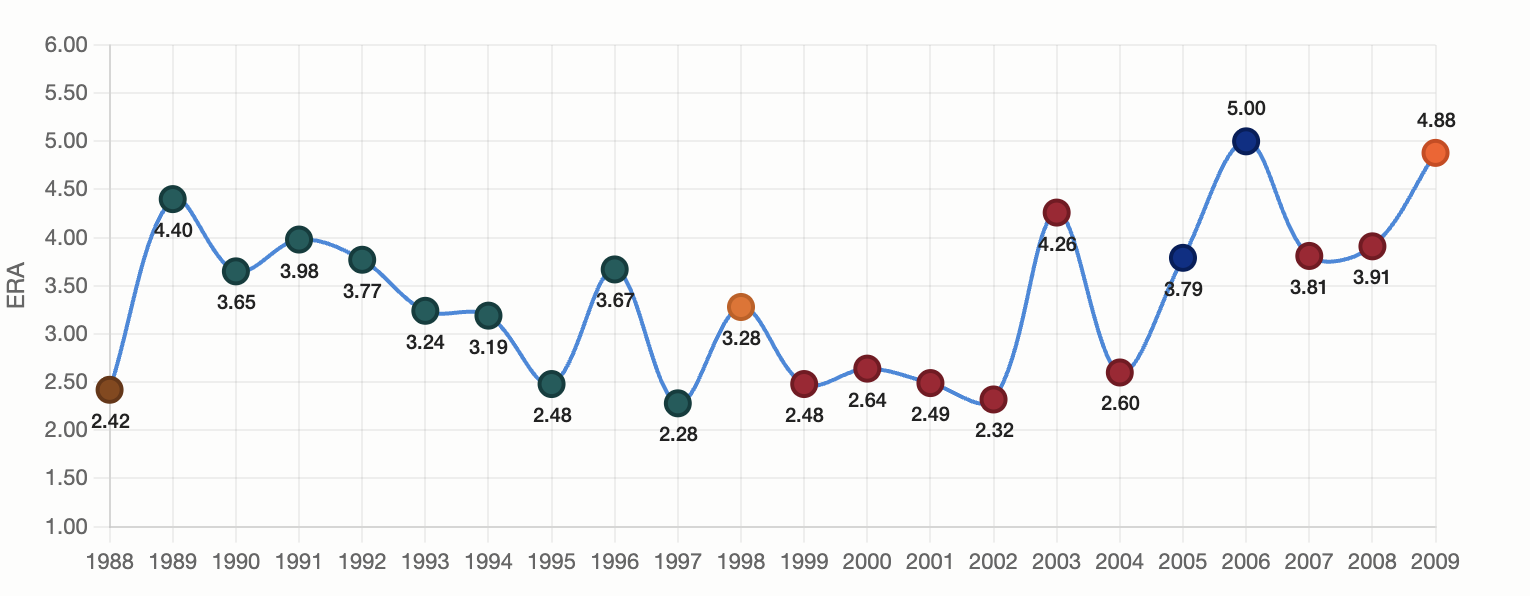
ERA by year
Finally Finding Closure
Over the last several years, though, something changed.
Johnson started appearing more relaxed and appreciative of his baseball history. Retirement seemed to soften him. The intimidating pitcher who once scared fans and reporters alike became known for his photography work and quieter life away from baseball. He suddenly felt more human, more reflective, and honestly more open than the version Seattle fans remembered from the 1990s.
The Mariners slowly reopened the relationship too, and that is what made this ceremony matter.
Not because it erased the tension or the complicated history. It did not. But because eventually, greatness becomes impossible to ignore. You cannot tell the story of Mariners baseball without Randy Johnson. You cannot explain how baseball survived in Seattle without him.
For years, the relationship between Randy Johnson and Seattle felt incomplete. This weekend finally felt like closure.