
What Can We Expect From Luis Castillo?
Much ado has been made about Luis Castillo the last couple years. Each offseason, you hear the calls from fans and media to dump his salary because he isn’t worth it anymore. The Mariners have made it clear that none of their starting pitchers are being traded, but that hasn’t silenced the critics. It’s true that he isn’t the same pitcher he was when the Mariners acquired him. His fastball velo is declining, he’s had more blow up starts, and his secondary offerings aren’t as effective. The 2022 version of Luis Castillo was a #1 starter, a true monster on the mound who dialed it up to 100mph in the playoffs and posted zeros on the scoreboard more often than not. The version we’ve seen in the last couple seasons has not been at that level, and considering the 5-Year, $108 million extension he signed in 2022, that understandably leaves a lot of people unsatisfied. But the death of Luis Castillo has been greatly exaggerated, and some of the criticism he has received has been undeserved, especially given the hurdles he has overcome along the way.
While we Mariners fans lamented his fall from grace, “La Piedra” remained one of the most valuable pitchers in baseball. According to Fangraphs, over the last two seasons, Castillo ranks 21st in WAR amongst all qualified starting pitchers in the MLB, 14th in ERA, 17th in FIP, and 12th in innings pitched. He may not be in the ace conversation anymore, but there’s still fewer than 25 pitchers who have been better over the last two seasons. His ability to post every day has been outstanding and is a huge reason why the 2025 Mariners were able to withstand losing George Kirby, Logan Gilbert, and Bryce Miller for large chunks of the season. Since his breakout season in 2019, he has the 3rd most innings pitched out of all qualified pitchers in MLB.
And this is all while battling constant elbow issues. When it came out in 2022 that his extension with the Mariners included an injury clause that would give them a team option in 2028 if Castillo missed more than 130 days with a UCL repair, the rumors started swirling. It’s been sort of an open secret ever since then, and is certainly still an issue to this day. In an interview with Seattle Sports’ Brock and Salk show on April 29, 2025, ESPN MLB Insider Jeff Passan marveled at how Luis Castillo has been able to be so effective and throw so many innings despite being “a guy whose elbow has been a mess for years”.
Yes, there certainly has been and will be reason for concern when it comes to Luis’s future production. But the track record is there that he can overcome it all and still produce as a workhorse in this rotation. Despite losing velo on his four-seam, he has continued to use it more often and still have success. It generated a +12 run value each of the last two seasons, and opposing batters are hitting just .200 against it. His arm slot has dropped slightly, down from 18 degrees in 2023 to 15 degrees in 2024 and 2025. This provides a bit of an advantage by making his delivery more unique, especially when combined with his bottom 1% extension. The other main reason for optimism is that he had the lowest walk rate of his career last season, and limiting walks is a quality all good aging pitchers have. He has also started to adapt to the decline in his stuff by adjusting his pitch usage and pounding the zone more often while allowing less contact in the zone. I suspect this change is due to improved pitch sequencing & tunneling and staying out of the middle of the plate. This is backed up by the fact that his meatball% (pitches that are middle-middle) dropped nearly a full percentage point in 2025. When you’re throwing thousands of pitches, one percent fewer mistakes matters a lot more than you think.
In simple terms, he’s starting to pitch like a true veteran. And this is exactly what you want to see from an aging pitcher. Nearly every pitcher goes through these same challenges as they age. Velo often declines in a player’s 30’s. But that doesn’t mean their careers are over. Some pitchers adapt, and continue to be effective as they age, like Nathan Eovaldi, who saw his velo decline from over 97MPH to 94MPH in his 30’s. Others, as we saw with Felix Hernandez, struggle to find their way without the overpowering stuff they once relied on.
Castillo’s critics would argue that his underlying metrics don’t look good, and point to his home/road splits as extra reason for concern. He gave up more hard contact last season and struck out fewer batters than before. And it’s true, there isn’t much red on his Baseball Savant Page. But that can be a bit misleading.
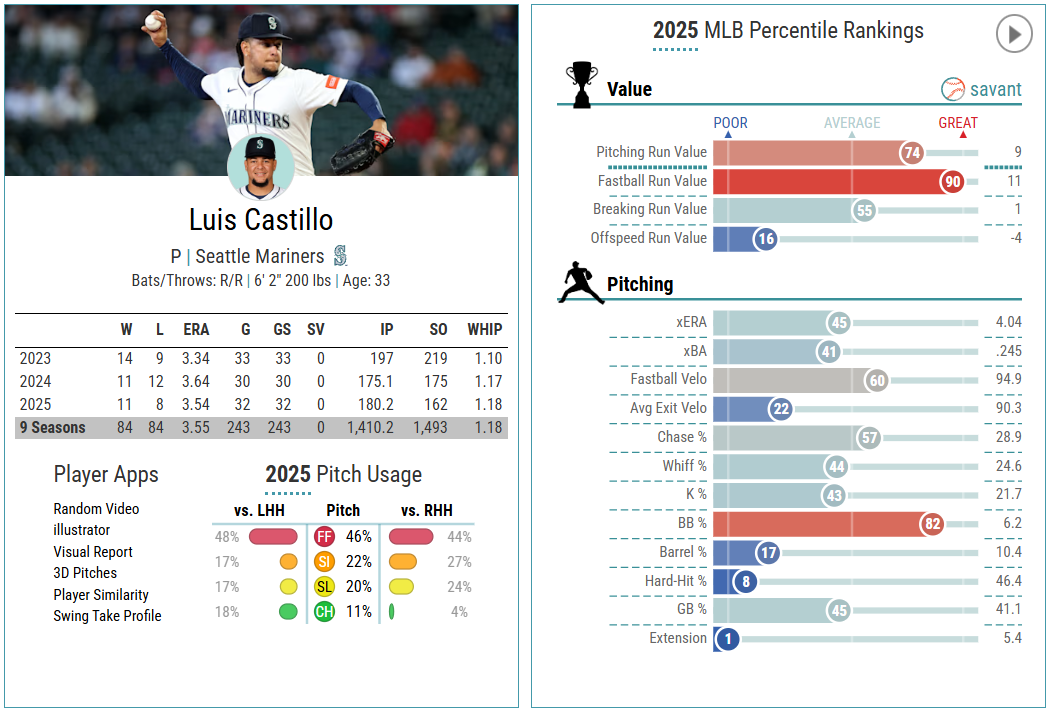
There are some players that consistently out-perform their underlying metrics, especially expected stats. Castillo has been in this group ever since coming to Seattle, which is to be expected given how pitcher-friendly the ballpark is. As for the home/road splits—look, I get it. It seems like Castillo can’t put up good starts on the road when looking at the numbers. But some difference is to be expected, as T-Mobile Park is very pitcher-friendly, and you have to account for the fact that these guys are used to pitching in that kind of environment. It makes perfect sense to design your pitches, strategy, etc. with your home park in mind. And it also doesn’t make sense to try and pitch in an entirely different manner when you go on the road. The Mariners pitching strategy revolves around throwing more pitches in the zone, and putting the onus on the batter to make a good swing in order to be successful, knowing that most of the time, especially at home, it will result in an out.
That’s why they target guys with good fastballs, which Luis Castillo still possesses. But sometimes on the road he is going to pay for the more aggressive style, because he cannot get away with as many mistakes on the road as he can at home. The decline in his stuff has exacerbated this effect, because he has even less room for error than before. However, a decent amount of the blame for his road splits being so terrible can be placed on plain old bad luck. Of his 15 road starts, 10 were against top half offenses in either OPS+, wRC+, or runs scored last season. He also had to pitch in some of the most offense-boosting environments in the game. He pitched in 9 stadiums with a park factor of 100 or greater (100 is average, over 100 means it is a hitter-friendly ballpark) according to Statcast’s 2023-2025 data. That doesn’t even include the Rays and Athletics’ AAA bandboxes, which both ranked in the top 10 for park factor in 2025 alone. All said, Castillo pitched 11 of his 15 road starts in average-to-above-average offensive enviornments.
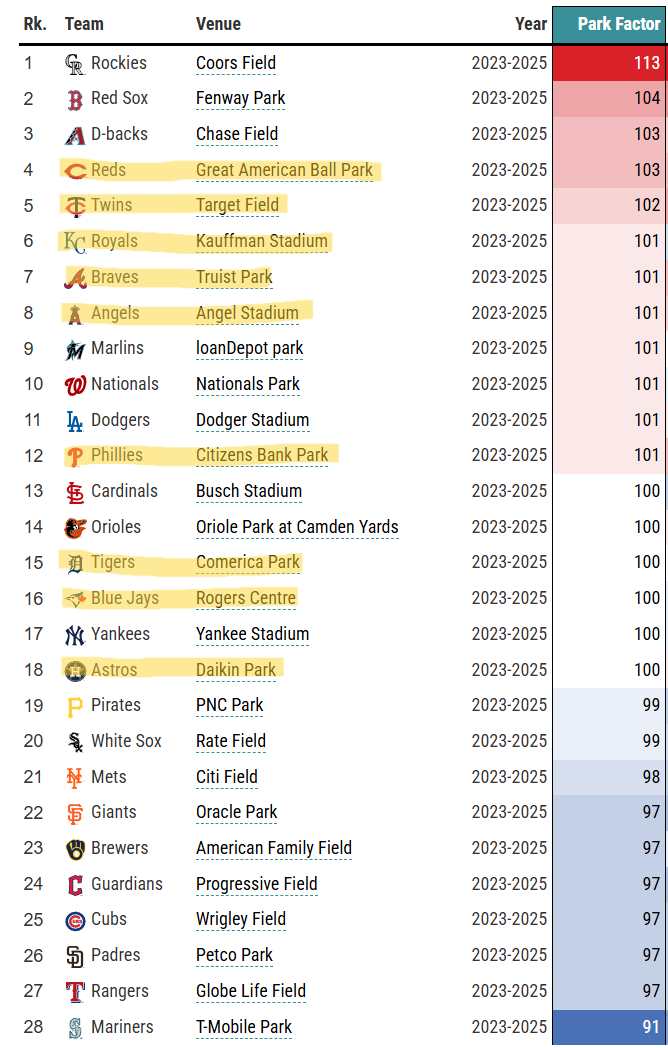
Statcast Park Factors 2023-2025
But he also had some big struggles in August that really skewed the data. Luis had a 3.54 ERA in 2025, but if you were to remove his four starts between 8/15 and 9/1, he would have had a 2.86 ERA over 163 2/3 innings. In his final four starts of the regular season he was fantastic, putting up a 2.45 ERA while allowing batters just a .167/.190/.275 triple slash over 29 1/3 innings. While taking out a bad month of data from a season could make any pitcher look better, this is a gap that would make the Grand Canyon blush. For example, even if you remove George Kirby’s atrocious May starts where he gave up 11 earned runs in just 8 1/3 innings, his ERA only drops from 4.21 to 3.68.
While it’s not fair to say a whole month of starts doesn’t count, it does tell us that this was a short-term setback, and not an accurate picture of who Castillo really is as a pitcher. The numbers over the last two seasons bear that out, and I think it’s foolish of us to count him out when he’s overcome every setback in his journey so far. He hasn’t been the ace we thought, but he’s still been well worth his contract—and a rock of stability in a season plagued by rotation injuries. As for next season, there’s no reason to think that he can’t have another productive year, even if it isn’t as pretty as we would like it to be.
