
Is the Bullpen Finished After the Ferrer Trade?
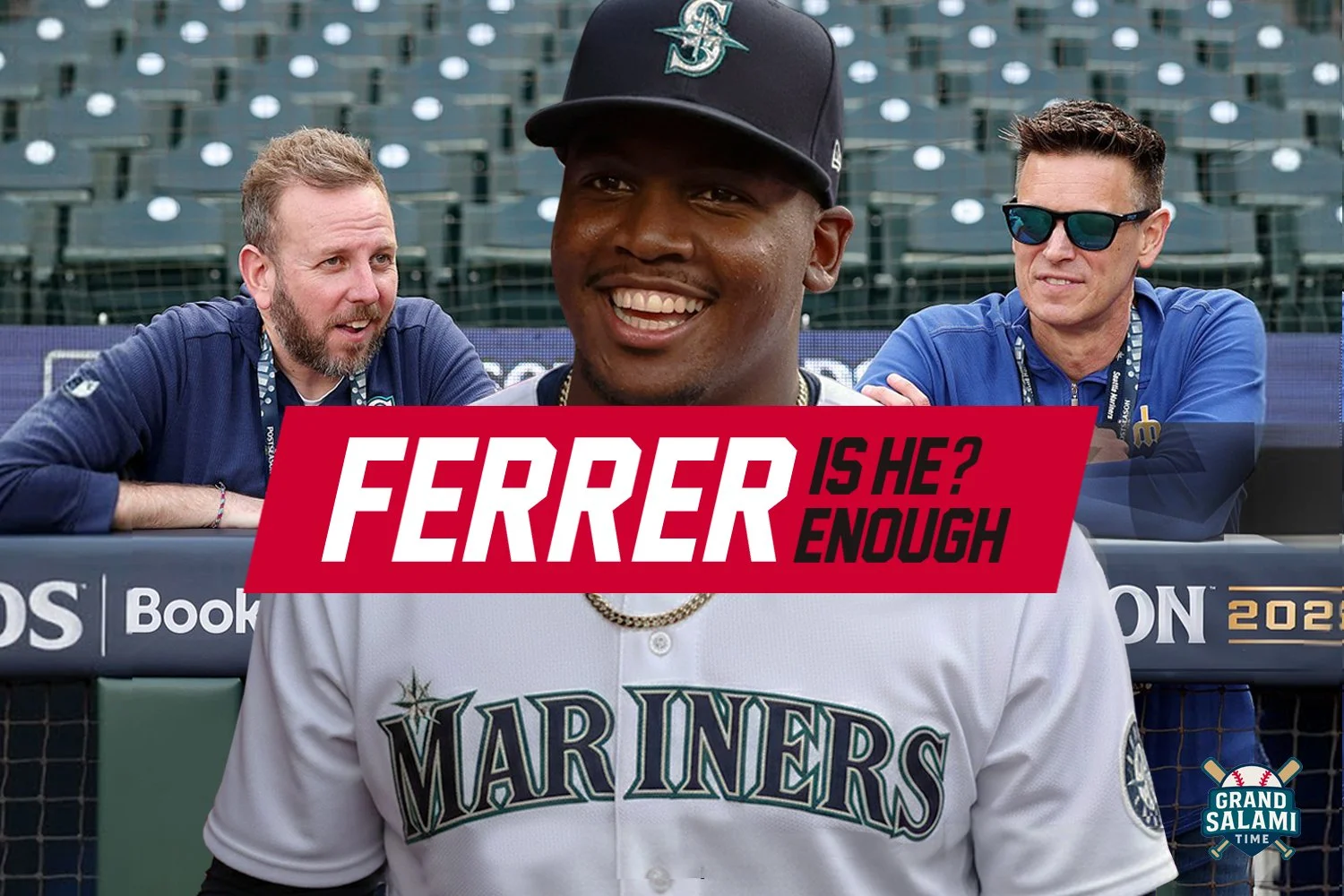
Ferrer: (Photo by Scott Taetsch/Getty Images)
Others: (Photo by Steph Chambers/Getty Images)
The Mariners finally made a move in the bullpen after weeks of rumors and speculation. Harry Ford and Isaac Lyon for Jose Ferrer. It seems like a lot to give up for a guy who isn’t an elite closer. It also seems like it isn’t enough to really round out the bullpen like the front office wants. Jerry Dipoto and Justin Hollander have made multiple comments indicating that the bullpen was going to be a priority this offseason; they even went so far as to say they needed relief pitching and admitted the bullpen got overworked at the end of the 2025 season. They were in on Johan Duran up until the 11th hour at the trade deadline, and were pretty dissapointed they didn’t get him, so the idea that they want to add that kind of impact this offseason makes sense.
At a glance, Ferrer looks like a middle-relief guy who isn’t going to move the needle. But the front office seems to disagree—Dipoto told the Seattle Times and MLB Network that Ferrer was their number one bullpen target, and Hollander stated, “We think that the surface [statistics] really does a disservice to how good he actually is.” Could Ferrer provide the production the M’s need? His career statistics give a clearer picture.

Jose Ferrer’s Fangraphs Stats
Jose Ferrer’s Savant Page
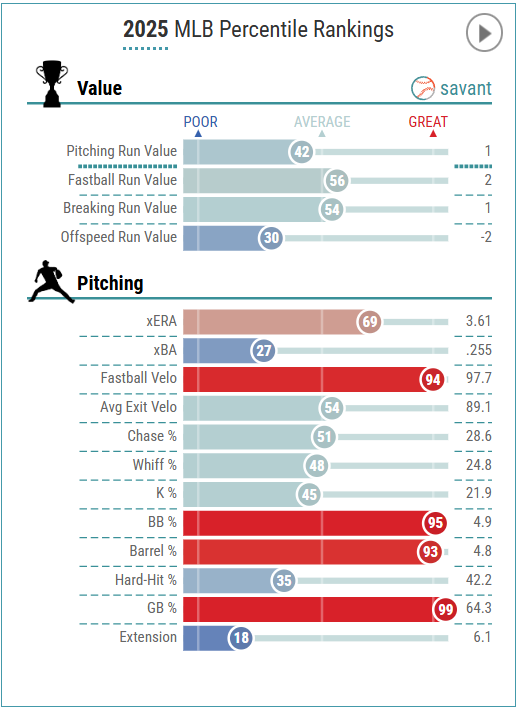
In 2025, he pitched his first full season, throwing 76.1 innings with a 4.48 ERA. At first glance this seems lackluster, but he also had a FIP of 3.03 and a groundball rate of 62.6%, among the best in the league. He is just 25 years old, with a strong sinker averaging 97.7 MPH and a changeup with excellent movement as a left-hander. He used to have a four-pitch mix with a sinker, 4-seam, changeup, and slider, but dropped the 4-seam in 2025 and exclusively used the sinker as his fastball. This led to a 5% increase in his groundball rate, pushing it into the 99th percentile among all MLB pitchers. He also avoids walks and barrels, which is ideal for a sinkerball pitcher. In 2025, the average launch angle of a batted ball against him was 0.8 degrees. In a MLB enviorment that prioritizes elevating the ball, an angle that low is elite.
Taking all this into account, Ferrer is clearly better than his surface stats suggest. As a young guy with elite stuff and strong underlying metrics, he has room to grow and could eventually become one of the better left-handed relievers in the game. He also fills an important hole in the M’s bullpen, giving them another strong option against lefties, who slashed just .186/.217/.304 against him last season. Ferrer is an excellent addition with upside, but he isn’t going to provide the same production as a pitcher like Duran. The Mariners still need more, and the front office agrees, as Dipoto has said they still expect to sign a veteran free-agent reliever this offseason.
But why did it cost Harry Ford and a throw-in prospect? It seems like an overpay, but many Seattle fans, myself included, have likely been overvaluing Ford. He has never been described as a well-above-average defensive catcher, and while his bat looked great in AAA, it is unproven at the major league level. He also wasn’t going to get a chance to improve his trade value because he lacks positional flexibility and is blocked by the best catcher in baseball. The Mariners had almost no leverage, as they needed to trade him before he became a backup and lost value. Harry Ford will almost certainly end up providing more value than Ferrer, but if he had stayed with Seattle, he wouldn’t have had the opportunity to provide that value at all. It was a move that needed to be made.
That leaves the question: what veteran free agent should the Mariners go after? To answer that, here are some of the best realistic options left on the market.
First up is RHP Tyler Rogers, my dream bullpen acquisition since the beginning of the offseason. Rogers is likely one of the best values in free agency from a cost-production standpoint. He will be 35 next year and is coming off arguably his best season ever. One of the few remaining submariners in the league, he has quietly been one of the most underrated relievers in baseball. Because of his age, he will likely get a 2-year contract with an AAV just under $10 million. But Rogers doesn’t rely on velo or athleticism to be effective, he relies on funk. Being one of the only submariners in the game has unique advantages because hitters aren’t used to seeing balls rise as they cross the plate. This suggests his production shouldn’t fall off sharply as he ages, meaning he has the lower price tag of an older player while being a less risky investment than the typical old reliever.

Tyler Roger’s Fangraphs Stats
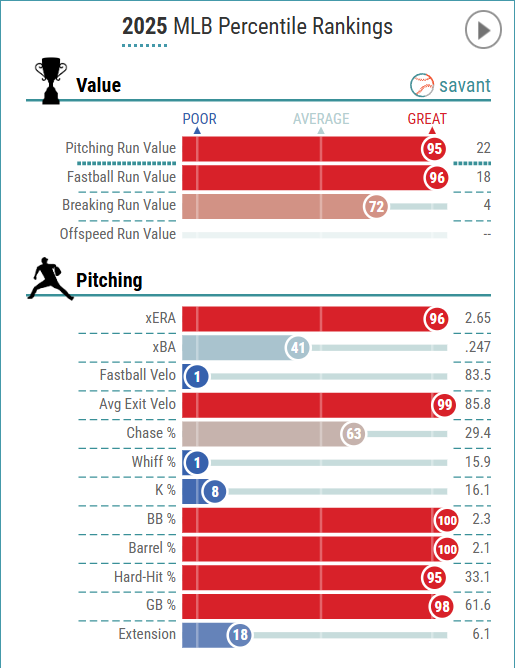
He averages just 83.5 MPH on his fastball and is still one of the more effective relievers in the game. In 2025, he had a 1.98 ERA, 2.88 FIP, and 0.94 WHIP over 77.1 innings. Rogers’ ability to limit hard contact is elite, ranking in the 99th percentile in average exit velo, 100th percentile in barrel%, and 95th percentile in hard-hit%. He is also elite at avoiding walks, with a 100th percentile walk rate. He is one of the best groundball pitchers in baseball, finishing in the 98th percentile in groundball rate. He allowed the 6th-lowest rate of batted balls pulled in the air and gave up only 4 homers in 2025. Pulling the ball in the air is ideal for hitters, often resulting in doubles and home runs. The only area where he struggles is strikeouts, with just a 16.1% strikeout rate and 15.9% whiff rate. Normally that would be a major red flag, but he is so elite in other areas that it doesn’t matter.
Tyler Roger’s Savant Page
While an AAV near $10 million would be pricey for the Mariners, especially as they are still trying to re-sign Jorge Polanco, it may still be worth considering.
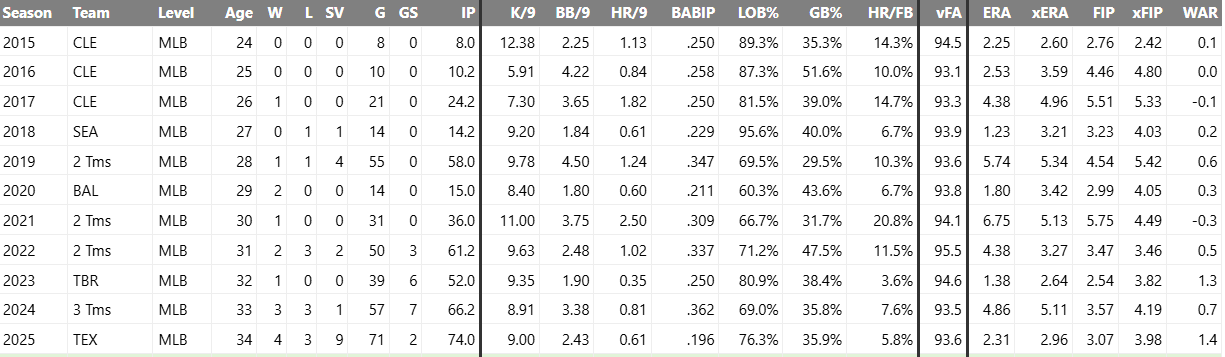
Another strong option that would cost a bit less is RHP Shawn Armstrong. Armstrong is similar to Rogers in that he doesn’t have great strikeout numbers but makes up for it in other areas. An important part of the Rangers’ top-5 bullpen last season, Armstrong posted a 2.31 ERA, 3.07 FIP, and 0.81 WHIP over 74 innings. He is a flyball pitcher who induces weak contact and limits baserunners. Even though he is a flyball pitcher, he had a 26% strikeout rate and allowed only 5 homers. He would be a great fit at T-Mobile Park, where the marine layer, cool weather, and low elevation help turn flyballs into outs. He is also 35 years old and is rumored to be seeking a 2-year deal worth $6–7.5 million AAV.
Shawn Armstrong’s Fangraphs Stats
Luckily, Armstrong already dealt with aging struggles when his fastball velocity dipped in 2024, dropping a full tick. He had one of the worst seasons of his career as a result. At the end of that season, he began throwing a sweeper for the first time since 2018, but it was too little too late. In 2025, he changed his pitch usage, dropping his slurve entirely and using the sweeper more often so that he used all four pitches at close to an even split. This kept hitters guessing and allowed his two fastballs to regain effectiveness without the higher velo. His sweeper and 4-seam fastball are legitimately great pitches, with both generating a whiff rate over 33% . With the youth of the M’s bullpen, Armstrong would make a strong veteran leverage arm at an affordable price. That makes him a great target for the Mariners.
There are other interesting names like Tyler Kinley, Seranthony Dominguez, and Caleb Theilbar, who would all likely be more affordable free agents. However, they carry more significant risks. Theilbar is 38, and although he seemed to have figured something out last season, the drop-off risk due to age is high. Still, after posting a 2.64 ERA, 3.00 FIP, and 0.88 WHIP over 58 innings in 2025 due to changes in pitch usage, leaning more on his slider and curveball, he is tempting. But at 38, it is hard to count on sustainability. He is also a lefty, and the M’s may not need another after acquiring Ferrer. Because he is older, he would likely be affordable and willing to sign a one-year deal if the Mariners wanted to take a chance.
Seranthony Dominguez and Tyler Kinley are in their early thirties with some very tempting traits, but both have big problems with command, with each of them walking over 10% of the batters they face. They also have below average fastballs, and rely on their breaking and off-speed pitches to get batters out. Last season, Dominguez had an ERA of 3.16, 3.47 FIP, and a 1.28 WHIP over 62.2 innings. Kinley had an ERA of 3.96, 3.69 FIP, and 1.18 WHIP in 72.2 innings. Dominguez has an excellent strikeout rate of 30.3%, and does a good job of limiting hard contact, but has one of the worst walk rates in the MLB. Kinley has a devastating slider that he uses 64% of the time but still doesn’t get a ton of strikeouts. Instead, his value lies in his ability to induce pop-ups and weak contact. He does have a changeup that performs really well when he throws it, but he uses it just 1% of the time. Both of these guys seem like great candidates for the Mariners pitching lab, but since they would cost real money to sign, it may deter them from taking a shot.
Final Thoughts
The Mariners made a bold first move by acquiring Jose Ferrer, a young left-hander with elite underlying metrics and significant upside. But this trade alone will not complete the bullpen overhaul the front office has prioritized. With several strong veteran relievers still available, including Tyler Rogers and Shawn Armstrong, the Mariners have a chance to add experience and stability to complement their young arms. Whether they choose the proven upside of Rogers, the affordability of Armstrong, or a calculated gamble on a riskier arm, their next decision will shape whether this bullpen becomes merely improved or truly elite.
