
The Mariners’ Achilles Heel

Christopher Sanchez, (Photo by Mitchell Layton/Getty Images); Chris Sale, (Photo by David Berding/Getty Images); Tarik Skubal, (Photo by Jamie Squire/Getty Images)
During the Mariners@Athletics series between May 25th and 27th, the Athletics made a decision that appears completely insane without proper context. They decided to push starting pitcher Luis Severino back two days, in favor of Gage Jump and Jeffery Springs. Luis Severino is the #1 starter in the Athletics’ rotation, who is being paid over $20 million this season. Gage Jump made his MLB debut during the series and had a 4.50 ERA over nine AAA starts in 2026, while Jeffery Springs is a veteran pitcher who has been performing around the same level as Severino so far in 2026. Starting a guy making his major league debut instead of your #1 without injury playing a role… that just doesn’t happen, for obvious reasons.
But they did anyways, because the Mariners have a major weakness. You see, Gage Jump and Jeffery Springs are both left-handed—and the Mariners currently struggle so mightily to hit lefties that the Athletics deemed it worthwhile to make such a bold move. Thankfully, it didn’t work out for them, because both Springs and Jump pitched terribly. It didn’t help that the Athletics play in a AAA bandbox in Sacramento, where the weather is hot and dry most of the year. But it highlights just how bad the Mariner’s issue is that an MLB team would go to such extreme lengths to throw more lefties at their lineup.
Normally, I like to dig deep into the numbers to evidence my points, but the numbers are so bad that you don’t have to look any further than average and OPS. Even with their success against two consecutive lefty starters in Sacramento, the Mariners are hitting a league-worst .208 against them as of 6/7/26. Their OPS vs lefties is an abysmal .624, 29th in the MLB. No matter how you slice it, they are one of the worst teams in all of baseball against LHP. Yes, they have a couple major bats missing right now, with Cal Raleigh out with an oblique injury after trying to play hurt for a month, and Brendan Donovan getting moved to the IL just 10 days after returning from his first injury of the year. The issue is, even if they get those guys back soon, it still won’t fix their lefty weakness. Neither Cal nor Donovan were hitting lefties well before landing on the IL, with both having an OPS under .400 against southpaws so far in 2026. Perhaps we can count on a healthy Raleigh to turn that around, but he alone cannot make up for such a massive deficit.
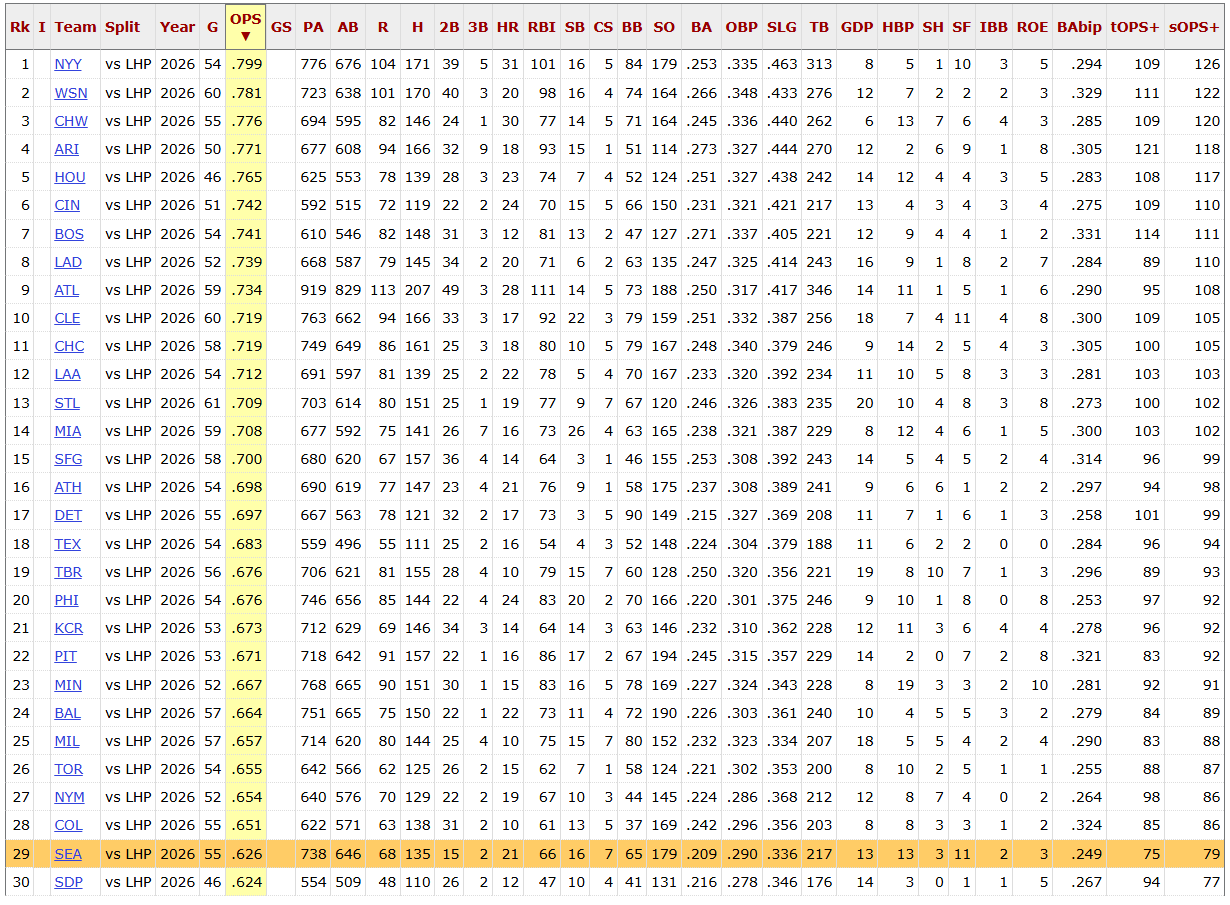
MLB Teams vs. LHP, Sorted by OPS
So, what’s causing this problem? Well, there are three major factors. First, the Mariners are extremely left-handed. Julio and Randy are the only right-handed everyday players they have. Naylor is left-handed, JP is left-handed, Cole Young is left-handed, and Brendan Donovan is left-handed. His replacement at third in Colt Emerson is also left-handed. Both of their best options at RF and DH in Canzone and Raley are left-handed. In general, left-handed hitters struggle against same-sided pitching across the MLB, and the Mariners are no exception. Luke Raley has repeatedly proven that he can’t hit southpaws to save his life, while the others have struggled more than usual. JP Crawford has had reverse or even splits in the past, but not so far this season. To put it simply, the Mariners don’t have enough everyday players hitting right-handed.
Second, the Mariners’ fix for this issue has failed. To get more right-handed bats against lefties, they planned to use platoons at RF, DH, and infield. The right-handed half of those platoons were intended to be a mix of Rob Refsnyder, Mitch Garver, Victor Robles, and Leo Rivas, but three of the four have been dealing with injuries this season. Victor Robles missed nearly two months with a pectoral strain, Mitch Garver has missed a bit of time with lower back tightness, and Rob Refsnyder was been playing through an unspecified knee issue. Rivas stayed healthy, but was struggling so much he got sent down to Tacoma a few weeks ago. The Mariners have tried to patch things up with internal candidates, calling up right-handers Connor Joe, Patrick Wisdom, and Jhonny Pereda to fill in as guys hit the injured list. Unfortunately, the band-aids didn’t do anything to stop the bleeding. Only Pereda has performed against left-handed pitching. As for the others, Connor Joe already dug himself a hole down to Tacoma, and Wisdom has been so bad he might not even get an offer from Korea this offseason.
Third, this LHP weakness also impacts the lineup against right-handed pitching. Canzone and Raley have been some of the Mariners best hitters this season. But they don’t trust them to hit against lefties, usually opting to pinch-hit for them when a lefty reliever comes into the game. So, the opposing teams bring in lefty relievers as soon as their starter is done, get Canzone and Raley out of the lineup, and then face a nerfed Mariners lineup for the rest of the game. Now, it would probably be better to just leave them in the game, but either way, it still hurts them offensively.
Their lefty/righty split is so bad that it drops their overall wRC+ from 119 to 109, the largest gap in the league. Despite this, the Mariners are still top-5 in wRC+ overall on the season, and over the past 10 games, the Mariners have been a bit better against left-handed pitching. Robles and Garver have been fulfilling their roles, Refsnyder has been a bit better, and the rest of the lineup has mostly improved their at-bats. Success in small sample sizes can leave as fast as it comes, but this is still an encouraging sign. In the regular season, they will face enough righties that it will mostly offset their struggles against lefties. But if they want to make it to the World Series, they will have to fix this weakness. Some of their biggest competitors in the AL have elite lefty starters, and it will absolutely cost them a playoff series if they run into the wrong team.
Mariners Offensive Splits (100 is average)
Southpaws Max Fried, Carlos Rodon, and Ryan Weathers are all on the Yankees, who you would almost certainly face en route to the World Series. That could be a matchup nightmare, with the M’s potentially facing four lefties in a 5-game series, or five in a 7-game series—not to mention that one of the other starters would be Gerrit Cole. The Guardians have Parker Messick, who is pitching very well this season. If the Tigers get their act together, they could have to face Tarik Skubal and Framber Valdez a combined 3-4 times in a playoff series. Thank God that the Red Sox suck because they have Garrett Crochet and Connelly Early. There are also some decent guys they will probably face once or twice more this season, like Reid Detmers, MacKenzie Gore, and Jeffrey Springs.
Jerry Dipoto or Justin Hollander should be looking very closely at potential right-handed bats to trade for at the deadline. Because it is very unlikely that the M’s platoon bats all stay good and/or healthy the rest of the season. Refsnider has been a complete failure, worth nearly a full negative WAR and running a wRC+ of 32 through his first 92 plate appearances. Robles has been good in his small sample size, and provides much better RF defense than Canzone or Raley, but there is no guarantee he keeps it up. And either Garver or Pereda will have to leave once Raleigh gets back from his rehab assignment.
The good news for Seattle is that this problem can be fixed relatively quickly. The Mariners have an extremely healthy organization, possessing a top-end farm system, depth at starting pitcher, and an extremely talented roster. Their rotation remains one of the best in baseball, currently 6th in ERA and 5th in FIP. Their bullpen ranks 2nd in ERA and 6th in FIP despite some of their best arms missing time this season. The lineup crushes right-handed pitching, ranking 4th in OPS and 2nd in wRC+ against them. All they lack is the finishing touches. This puts them in a perfect position to add a piece or two at the deadline and push for a championship.
October baseball is about exploiting weaknesses, and right now opposing teams have identified Seattle's biggest one. The Athletics were willing to rearrange their rotation and start a pitcher making his major league debut because they believed the Mariners were vulnerable to left-handed pitching. That should be a wake-up call. Seattle may have won those games, but the fact that another organization felt comfortable making such an aggressive move speaks volumes about how the league currently views this lineup. No matter where the solution can be found, the Mariners must find it, because they cannot afford to remain the worst team in baseball against left-handed pitching. If they do, it could cost them everything they have spent years building up to. If they can just find a way to become average against lefties, however, their ceiling remains as high as any team in the American League. Now it’s up to the front office to make sure one glaring weakness doesn't keep a World Series-caliber roster from reaching its full potential.
-Isaac Harai
