
Is Cal Raleigh Destined For Decline?
Usually at this time of year, all the buzz is about the talented prospects that could soon make the major league roster and the incredible feeling of hope that comes along with it. Mariners fans have grown used to dreaming on top prospects instead of Major League talent at this time of year. Names like Kade Anderson, Ryan Sloan, and Colt Emerson are everywhere right now. The WBC drama is dominating social media. But still, something is different this season. Despite the thrill of having some of the best prospects in baseball and juicy stories aplenty, the minds of Mariners fans are more focused on the major league roster than ever before, after coming up just shy of their first World Series in October.
Because now, the major league roster doesn’t need a bunch of rookies to contribute heavily to be a serious contender. They have zero rookies in the projected rotation or opening day lineup. All the most likely candidates for the bullpen have already pitched in the majors before. For the first time maybe ever, the Mariners are not relying on unproven prospects for success. Sure, they will need them to step in when injuries inevitably come during the long season. Ryan Sloan and Kade Anderson could be ready this year to take over if the Mariners sustain any pitching injuries, and Colt Emerson may still be able to force himself onto the opening day roster with a crazy finish to spring training. But they don’t need a single prospect to make the team right out of the gate to fill their roster. Because the roster is the most complete it’s been in decades.
That shift changes the conversation. Instead of focusing on which young players will step up, the spotlight turns to the stars that are already here. And no one is more consequential to this team’s ceiling than Cal Raleigh. His breakout 9.1 fWAR, 60-homerun season makes that crystal clear. Because it was so unexpected, it feels as though he must come back down to earth now. Which begs the question, what can we realistically expect out of our Big Dumper this season?
To answer that, we have to understand what drove the breakout. How much of it was good fortune, and how much was real improvement in skills? And is that level of production sustainable? Baseball is a process driven sport, and improving the process is what leads to long-term success. So, what did he change? Well, the biggest thing, as everyone noticed, was his right-handed swing. In the past, it was completely different from the left, and his numbers from that side were not great. But in 2025, his left and right-handed swings were much more symmetrical, and his results improved dramatically, posting a 150 wRC+ as a lefty and 186 wRC+ as a righty.
According to Statcast, he had an identical attack angle of 18° from both sides of the plate. Attack angle is the vertical angle the ball and bat make when they connect. It’s hard to understand without a visual, so I’ve included some below.
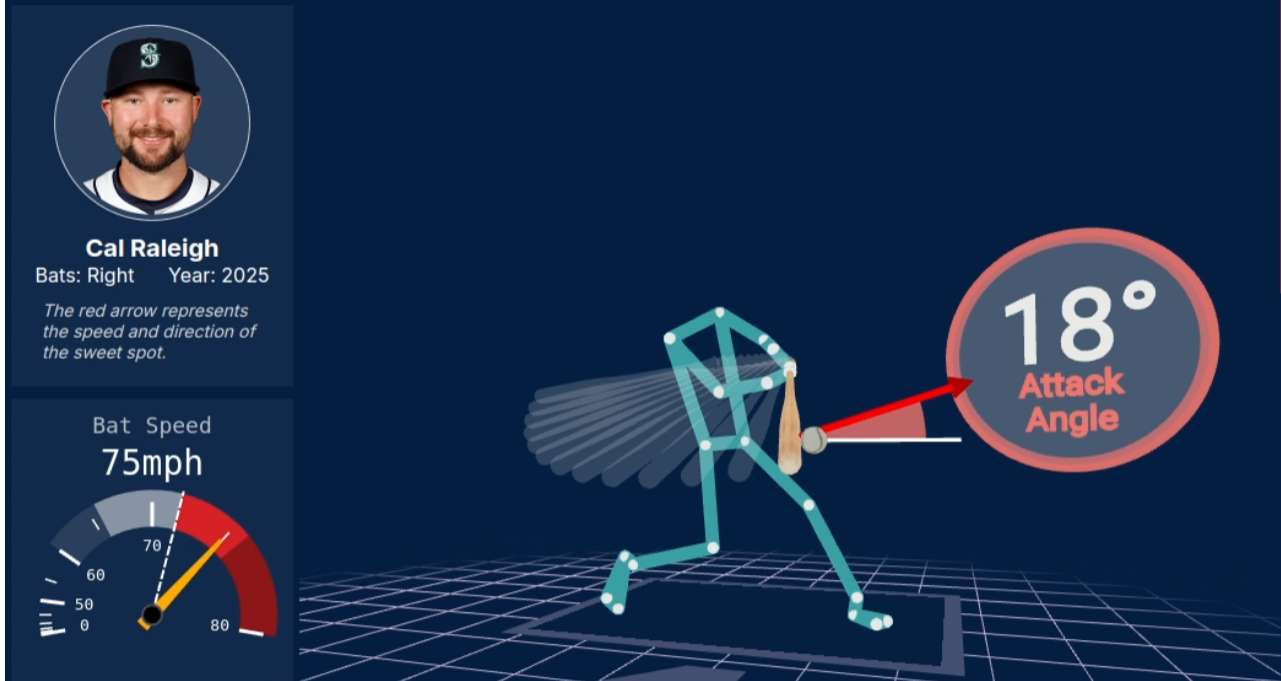
Cal Raleigh’s Right-Handed Attack Angle (Baseball Savant)
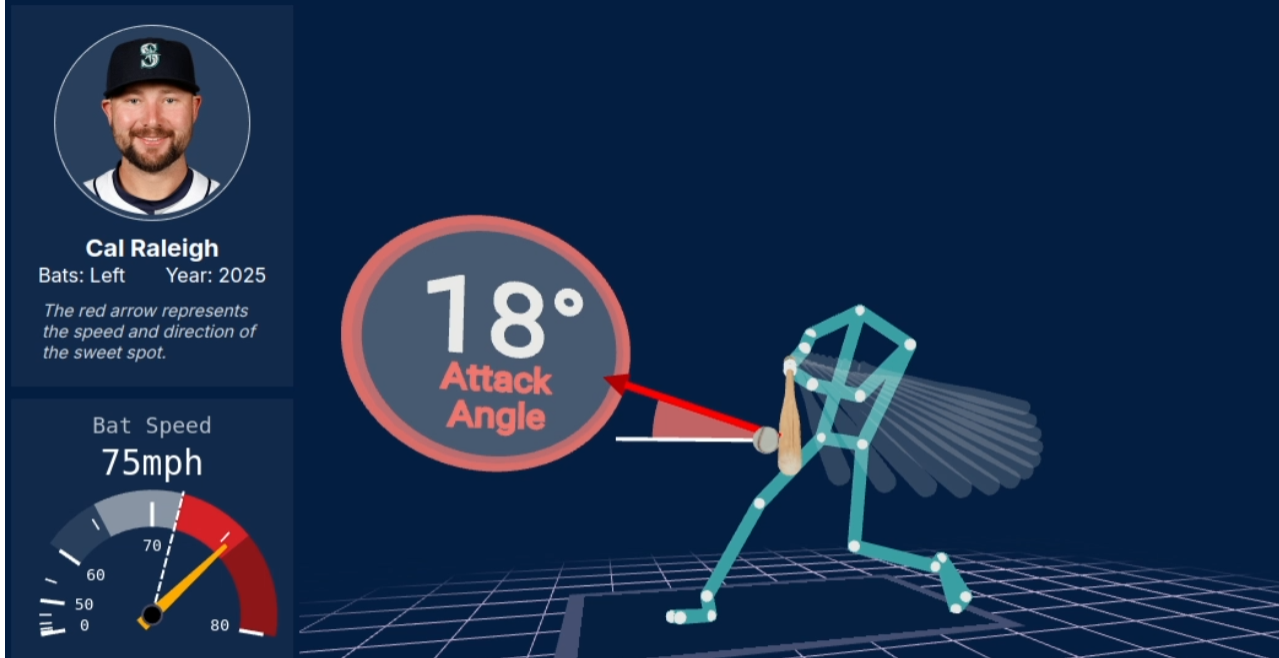
Cal Raleigh’s Left-Handed Attack Angle (Baseball Savant)
He also made some changes to his stance in the batter’s box to keep things more consistent. He starts with his feet closer together, and on average they were exactly 24.8 inches apart from both sides of the plate. In the past, they were a bit further apart on one side. He also moved slightly closer to the plate on both sides. With all these adjustments, Raleigh’s swings are practically twins, and it can be difficult to tell them apart visually.
They still have their differences, though. When he takes his stance from the left side, he puts his foot closer to the back of the batter’s box (further away from the pitcher), whereas on the right, he stands a few inches closer to the pitcher. His right-handed stance is also slightly more open than the left, and he opens his hips up a bit quicker and more completely on that side as he finishes his swing. This resulted in a slightly larger angle of pull-side attack direction, which is the angle the bat and ball make on the horizontal plane. In contrast, he keeps his lead foot and hips closed a bit more on the left side, which is typically seen as a positive thing by swing coaches. The general consensus is that opening the hips too soon can result in a plethora of issues. The easiest one for the average fan to spot is being early, which results in pulling the ball more often. That in turn often results in difficulties keeping the ball fair. The difference in Raleigh’s swings seems to be corroborated by the batted ball data as well, as he pulled the ball more often from the right side of the plate.
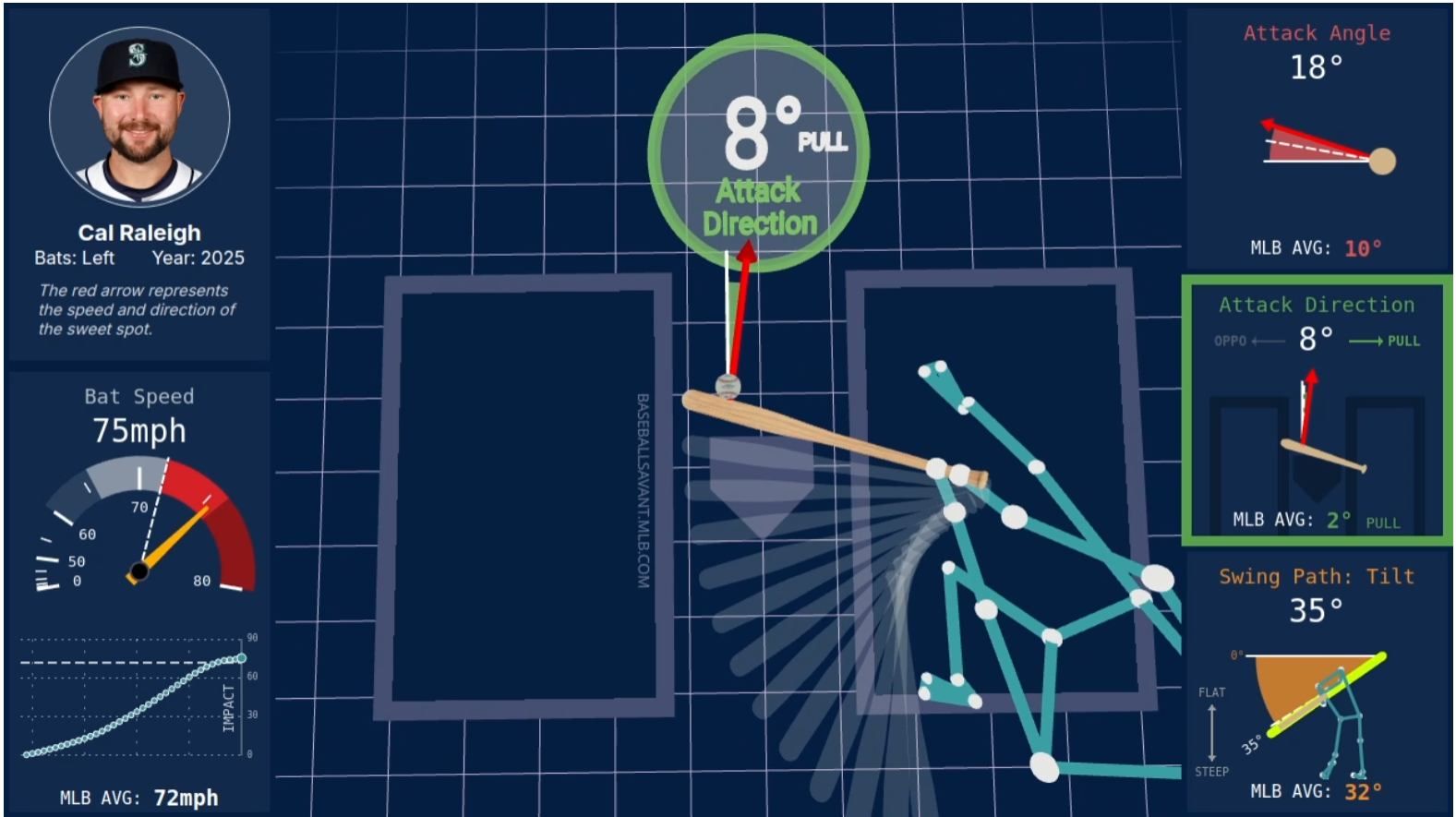
Cal Raleigh’s Left-Handed Attack Direction (Baseball Savant)
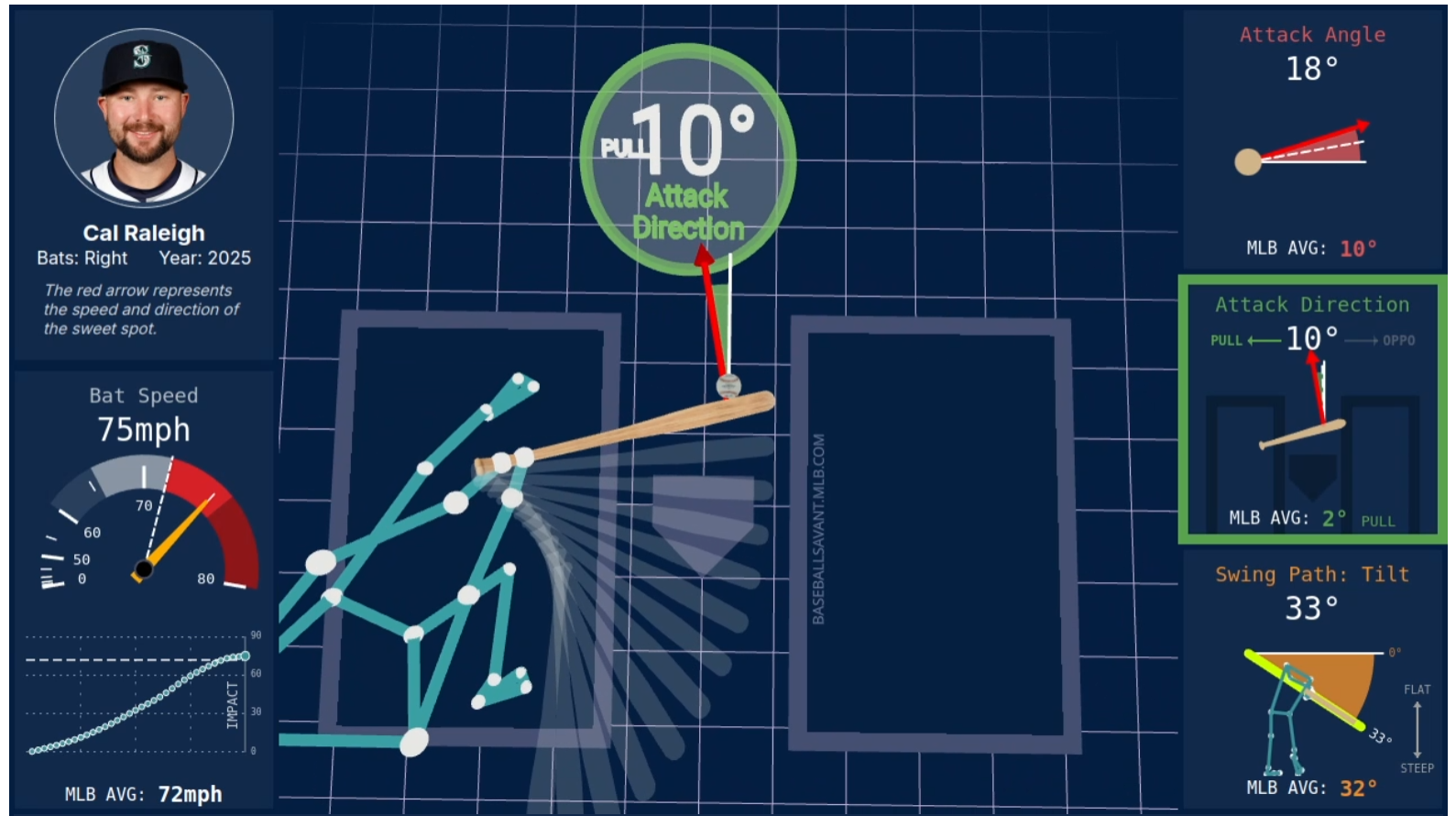
Cal Raleigh’s Right-Handed Attack Direction (Baseball Savant)
Raleigh also had a tough time covering the whole plate from the right side. He consistently rolled over pitches in the upper outside and lower inside sections of the zone, but absolutely crushed pitches that were in any other section. From the left side, he was able to adjust his bat path to pitches in almost every section of the zone at the cost of slightly lower production overall. He didn’t have any issues with rolling over the ball, as his ground ball rates were exellent in every section of the zone. However, he still struggled to make a whole lot happen in the top outside section. His ability to adjust better from the left side is particularly noticeable when you look at his numbers on pitches outside the zone. As a lefty, Raleigh is an above average bad-ball hitter. As a righty… not so much. It isn’t clear that those slight differences between his setup and swing angle are the culprit, though. It’s entirely possible that he simply isn’t as comfortable swinging from the right, because he has fewer at-bats from that side.
The Zone Heatmaps on the left side are from Cal Raleigh hitting left-handed. The ones on the right are from him hitting right-handed.
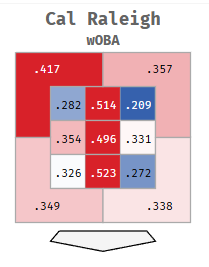
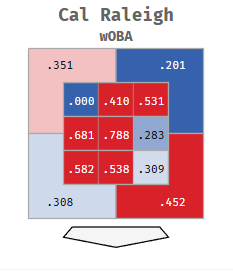
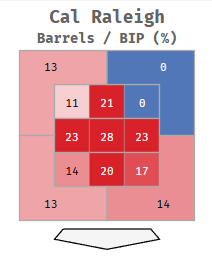
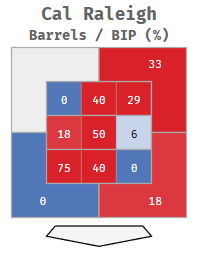
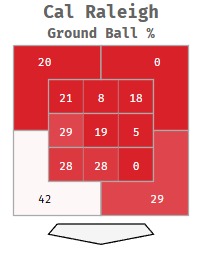
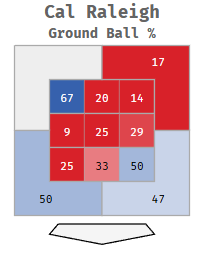
While Raleigh may be pull-happy, especially as a righty, he is clearly using it to his advantage. Pulling the ball isn’t always a bad thing, as long as it stays fair, and in the air. I’ve touched on this in previous articles, but pulling the ball in the air is the best possible scenario for batters (if it isn’t foul). They consistently lead to better outcomes vs. batted balls with the exact same exit velo and launch angle. This is because statistically, pulled balls in the air are more likely to end up being a hit or home run than any other batted ball type. Raleigh posted one of the best pull air rates in the majors, second only to Isaac Paredes. On those batted balls, Raleigh posted a jaw-dropping 2.173 OPS. So, while it’s true that he outperformed his expected stats, it wasn’t because of luck.
This is one of the best examples of how expected stats like xwOBA (expected weighted on base average) can fall short—because batters with extremely high pull air% almost always have a higher wOBA(weighted on base average) than xwOBA. This is because xwOBA does not consider whether the ball was pulled, center, or opposite field. But it isn’t as simple as just trying to pull the ball more. Defensive shifts, the fact that it still needs to be hit in the air, and the aforementioned plethora of issues that being too pull-happy can cause, are all major roadblocks most hitters don’t overcome. There is a line between pulling the ball enough to take advantage of this fact and pulling it so much that it ruins your offensive production. Some of the best hitters in the MLB have the ability to toe that line. Caleb “The Big Dumper” Raleigh danced all over it.
Cal Raleigh's 2025 Numbers (Batted Balls In The Air, Pulled vs. Not Pulled)
Pulling the ball wasn’t the only thing his stance/swing changes improved though. The one thing that every good hitter must be able to do is hit fastballs. If you can’t hit those, pitchers won’t even bother throwing their other pitches. In 2024 and earlier, Cal Raleigh was much better against breaking and off-speed pitches, and he struggled to consistently hit against fastballs. He always did well against sinkers, but not four-seam fastballs. Unfortunately, four-seam fastballs make up over 30% of the pitches he’s seen in his career, while sinkers are less than 10%, so it was a weakness that could be exploited. But in 2025, Raleigh turned that weakness into a strength, crushing all fastballs. Against four-seamers, he had an OPS of .925 and a 164 wRC+. Against sinkers, he was even better, slugging 1.000 with an OPS of 1.476 and a 305 wRC+.
And the fact that Raleigh achieved his success over the course of 705 plate appearances in the regular season before proceeding to demolish the ball in the postseason… well, that speaks volumes as to how sustainable his improvements are. Raleigh’s first half of 2025 was hot, and he finished the season hot as well, with a wRC+ of 220 in May and 191 in June, then 183 in September and 193 in the postseason. In the playoffs, he was beat up, exhausted, and facing the best pitchers opposing teams had to offer, but he still produced at double the rate of the average hitter. This indicates real, massive, long-lasting improvements.
The Big Dumper is unlikely to slow down now — he has made improvements to his game every single season he has been with the team. After an unsuccessful cup of coffee in 2021, Raleigh came back in 2022 with a much-improved bat, producing 4.2 fWAR. In 2023, it was the defense that saw an improvement, and he cut down his strikeout rate at the plate as well, finishing with 4.3 fWAR. In 2024, he made major improvements on both sides of the ball, improving his walk rate and quality of contact while also taking his defense to the elite level — winning both a Gold Glove and the Platinum Glove. And of course, we know what happened in 2025, when he finished as the runner-up in a controversial MVP vote. Stance and swing similarity is something I fully expect to see further refinement in this upcoming year. If he is able to continue making adjustments, he could improve his contact rates and tap into his power more often than before, which is a thrilling thought for Mariners fans.
Unfortunately, his defensive WAR dropping was probably the only reason he didn’t win the MVP. But what was it that made his defense dip in 2025? Well, it was mostly due to the ever-shrinking strike zone in the MLB. The league changed its policy on how they evaluate umpires, tightening the margin of error or ‘buffer zone’ they are judged on. In prior seasons, an umpire would only be negatively impacted in their performance evaluations for missed calls that were more than two inches off the plate (as measured by the pitch tracking system). In 2025, they would only be given the benefit of the doubt if they were less than 0.75 inches off. They also changed how the buffer zone worked—prior to 2025, only missed calls outside the zone that were given a margin of error, while pitches inside the zone were not given a buffer at all. This led to umpires being more likely to call a borderline pitch a strike, because it was less likely to affect their reviews.
So, in 2025, the 0.75 inch buffer zone was extended to both inside and outside the strike zone, which gave them a bit of leeway no matter which way the call went. This led to a noticeable decrease in borderline strikes, especially at the top of the zone. The top of the zone historically has been an area where it was easier to steal strikes, because the definition of the top of the zone is “the midpoint between the batter’s shoulders and the top of the uniform pants when the batter is in his stance and prepared to swing at a pitched ball”. Whereas the bottom of the zone is simply, “just below the kneecap”. You can understand how the definition of the top of the zone would be much harder to judge. The ABS strike zones nowadays are pre-calculated based on player’s heights and do not account for the batter’s stance.
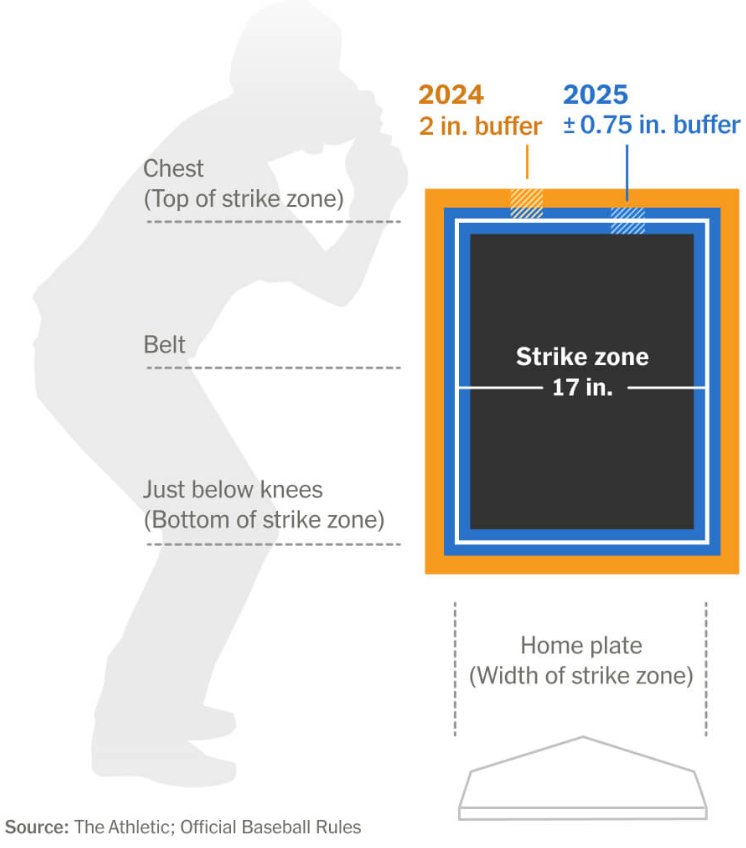
After years of being judged on computer-generated strike zones, this became less of an issue, but with the two-inch buffer outside the zone and zero margin for error inside the zone, 2024 umpires were still much more generous on the top rail than any other part of the zone. Cal Raleigh was one of the best in the MLB at framing those high pitches, and got a lot of calls to go his way that season. But in 2025, those strikes simply weren’t there to steal. Umpires were much stingier with those high strikes because they would be judged on misses both outside and inside the zone. That is exactly why he is working on framing at the bottom of the zone, according to his spring training interviews.
The best part is that Raleigh is still on the right side of 30, with the added benefits of being both a late bloomer and a hitter that does not rely on his speed for value. Even though he has played a ton of games in the last couple years, he didn’t play his first full season until age 25. He’s accumulated less wear and tear than one might expect from a catcher entering their age-29 season. As he gets older and slower on the bases, it won’t affect his value much because that isn’t his strength anyways. It will be very interesting to see how much he can improve his defensive skills in this upcoming season, because if he makes a significant improvement, he may once again be a gold-glove level defender. The impact of the challenge system will also be intriguing, as Cal is known for his eye both at the plate and behind it. If he can pull off an elite rate of successful challenges, I think he could add even more value to the team than ever before.
With all that said, health is really the main reason for concern, especially after playing so many games last season and choosing to participate in the WBC before this season even starts. Injuries are often the real culprit of production drop-offs in a players 30’s, not declining skills. Most elite hitters have the talent and ability to produce even later in their careers, but are derailed by a constant stream of injuries. This is because aging reduces the body’s ability to heal and recover, and the wear and tear of many seasons in the league increases the likelihood of injury. This is one of the main reasons steroid era hitters were able to be so productive later in their careers, as PED’s greatly improve the body’s ability to recover and heal. Raleigh may have less wear and tear than the average 29-year old catcher, but overworking your body over shorter periods of time can impact injuries just as much as long-term accumulation. The Mariners probably have a plan to give him more days off than last season, and because of that, it is unlikely that he will put up more WAR than last season. It will also be tough for him to hit as many home runs, due to a reduced workload and the fact that pitchers will undoubtedly pitch around him more often. But he has surprised us several times in the past, and there is no reason to believe he can’t surprise us again.
The most reasonable expectation for Cal Raleigh in 2026 is continued evolution. His historic peak from 2025 may represent the high-water mark in terms of raw numbers, especially if Dan Wilson manages his workload more carefully in the future. But Cal Raleigh is not a player who just happened to stumble into a legendary season. He has continually improved his skills each year. The process improvements that fueled his 2025 season are too legitimate to doubt. The swing changes, fastball dominance, and sustained production over a full year all point to a player who has truly elevated his baseline. It should come as a surprise to no one if Raleigh improves his skills further in the future. Health permitting, he should remain one of the most impactful catchers in baseball and the centerpiece of a roster that no longer depends on potential, but on proven excellence. The Mariners wait no longer for their bright future. The future is now. And as long as the Big Dumper continues on his path of dominance, the ceiling for this team remains as high as it has ever been.
-Isaac Harai
